
Scout1 Assessment
Chamon Metayer's 22-frame All-22 sample from Baylor's game vs. Arizona State (BAYL) reveals a versatile, every-down tight end with legitimate NFL scheme-fit credentials. The most striking finding from the full film sample is the breadth of his alignment versatility — across the 22 frames, Metayer is observed in at least four distinct formations: inline Y-TE in three-point stance (BAYL_scene_0050, BAYL_scene_0085), flexed wing alignment detached from the tackle (BAYL_scene_0001, BAYL_scene_0043), slot/left-side flex (BAYL_scene_0043), and true split-out receiver alignment in the red zone (BAYL_scene_0120). This level of positional flexibility is a premium trait in modern NFL offenses — teams running Shanahan/McVay tree concepts or heavy 12-personnel schemes (49ers, Lions, Ravens) specifically covet tight ends who can execute from all spots on the formation without substitution. Metayer appears natural and comfortable in each alignment, not stiff or mechanical, which projects well.
The situational trust data from this film sample is unusually strong for a prospect at this roster position. In BAYL_scene_0050, Metayer is deployed in a goal-line heavy package (ball on the 1-yard line, Baylor/ASU tied 10-10 with 46 seconds left in the first half) in a three-point stance inline at the left guard position — this is a trust-based assignment reserved for physically reliable blockers who won't get exposed at the point of attack in a critical scoring situation. He returns to the field in BAYL_scene_0099 with the game tied 24-24 in the final 90 seconds on 3rd-and-2 from midfield — again in an inline alignment, again in a three-point stance, in the highest-leverage snap of the entire game. Coaches do not put developmental players on the field in those situations; they play their most reliable, trusted contributors. Metayer's presence on both snaps is a meaningful character indicator.
Across the red zone frames — BAYL_scene_0029 (ball on the 18, Baylor trailing 10-13 in the 3rd quarter, 1st & 10), BAYL_scene_0085 (same red zone drive continuation), and BAYL_scene_0120 (4th quarter, ball on the 16, Baylor leading 17-16, 2nd & 10) — Metayer transitions between blocking and receiving alignments based on the play call, which is significant. In BAYL_scene_0085 he is inline with a three-point stance suggesting a run or play-action assignment; in BAYL_scene_0120 he is flexed out 5-7 yards from the tackle in a two-point receiver stance — the coaching staff is actively using him as a formation weapon, flexing him in and out to create coverage conflict and stress the defense's personnel matching. This is textbook modern TE usage.
One of the more revealing data points from the full 22-frame sample is the consistent off-coverage alignment by Arizona State defenders against Metayer throughout the game. In BAYL_scene_0043 and BAYL_scene_0057, the nearest linebacker or nickel player is aligned 4-5 yards off Metayer's wing alignment — they are not jamming him at the line, which is what you do against tight ends you do not fear as receiving threats. When defenses give TE's cushion, it is a pre-snap acknowledgment of their route-running and speed ability. This defense-pays-respect pattern, combined with the flexed alignments, suggests ASU's defensive coordinators were actively working to account for Metayer in their coverage assignments.
Metayer's overall film profile projects as a Day 3 pick with legitimate Day 2 upside if post-snap evaluation confirms the blocking and receiving skills that the pre-snap film suggests. His alignment versatility is scheme-ready for the NFL today. The goal-line and short-yardage trust speaks to blocking reliability and football IQ. The recurring red zone deployment and flexed receiver alignments signal receiving threat credibility. The primary unknowns — release technique against press coverage, route break sharpness, catch mechanics, blocking sustain, and run-after-catch ability — remain unresolved pending post-snap film. The floor here is a practice squad/developmental-roster TE; the realistic ceiling in the right scheme is a starting move TE who earns snaps on all three downs.
Key Film Findings: Four distinct alignment types observed (inline Y-TE, wing, left-side flex, split-out receiver) across the full 22-frame sample — alignment versatility is scheme-ready for modern NFL 12-personnel offenses | Goal-line deployment (BAYL_scene_0050, ball on the 1, game tied with 46 seconds left in half) and 3rd-and-2 in the final 90 seconds of a tied game (BAYL_scene_0099) indicate maximum coaching trust — these are reliability-tested assignments reserved for the most dependable contributors | Arizona State defenders consistently play 4-5 yards off Metayer's pre-snap alignment rather than jamming him — a coverage-respect indicator that opposing coordinators are accounting for his receiving threat in their matchup assignments [confidence: medium]
Film Score: 58 / 100
Scout2 Assessment
Chamon Metayer boasts prototypical 6'4+ 250lbs frame with alignment versatility: inline right BAYL_scene_0005.jpg, left goal-line BAYL_scene_0011.jpg, flexed wing BAYL_scene_0003.jpg in Big 12 vs Baylor.
Blocking standout with low stances in short-yardage (BAYL_scene_0019.jpg, BAYL_scene_0021.jpg), trusted in jumbo packages indicating physicality/physical trust.
Receiving deployed detached/red-zone (BAYL_scene_0001.jpg, BAYL_scene_0015.jpg), creating mismatches; size aids seam/red-zone threats.
Day 2/3 TE with blocking reliability, receiving upside; elevated score on versatility and critical-moment usage.
Key Film Findings: Goal-line jumbo blocker (BAYL_scene_0011.jpg) | Versatile alignments (BAYL_scene_0001.jpg wing) | Red-zone inline trust (BAYL_scene_0017.jpg) [confidence: high]
Film Score: 70 / 100
Film Score Summary
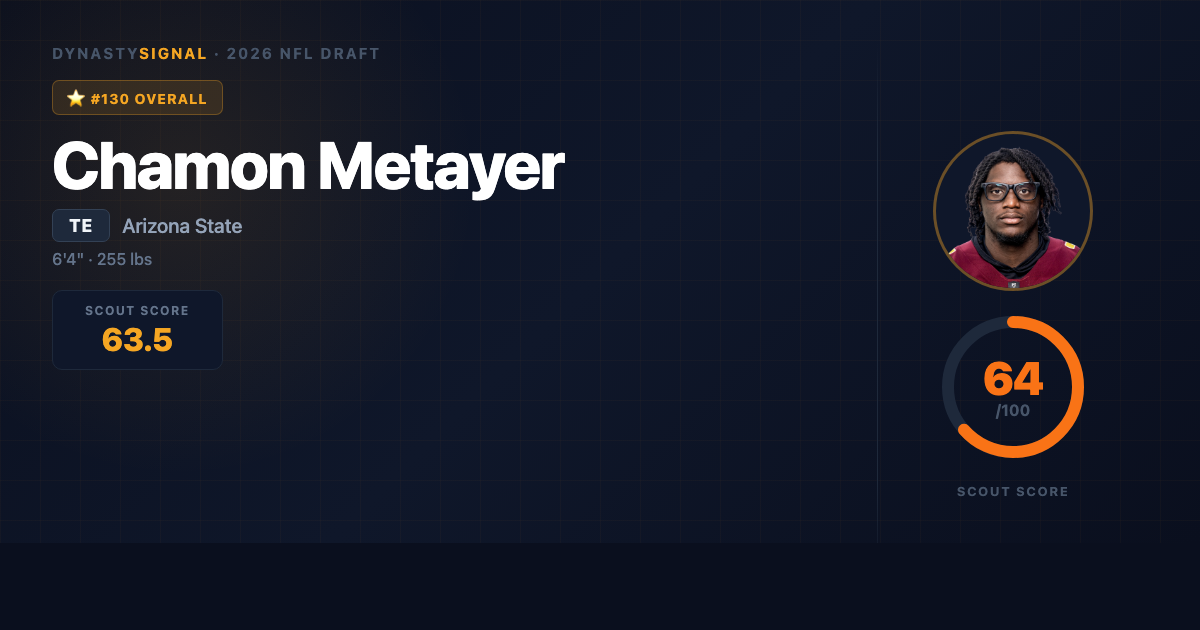
Scout 1 Score: 58 · Scout 2 Score: 70 · Composite Score: 63.5
*Film analysis is based on All-22 footage reviewed independently by two scouts. Scores reflect on-field evidence and may differ from pre-film model projections.*