
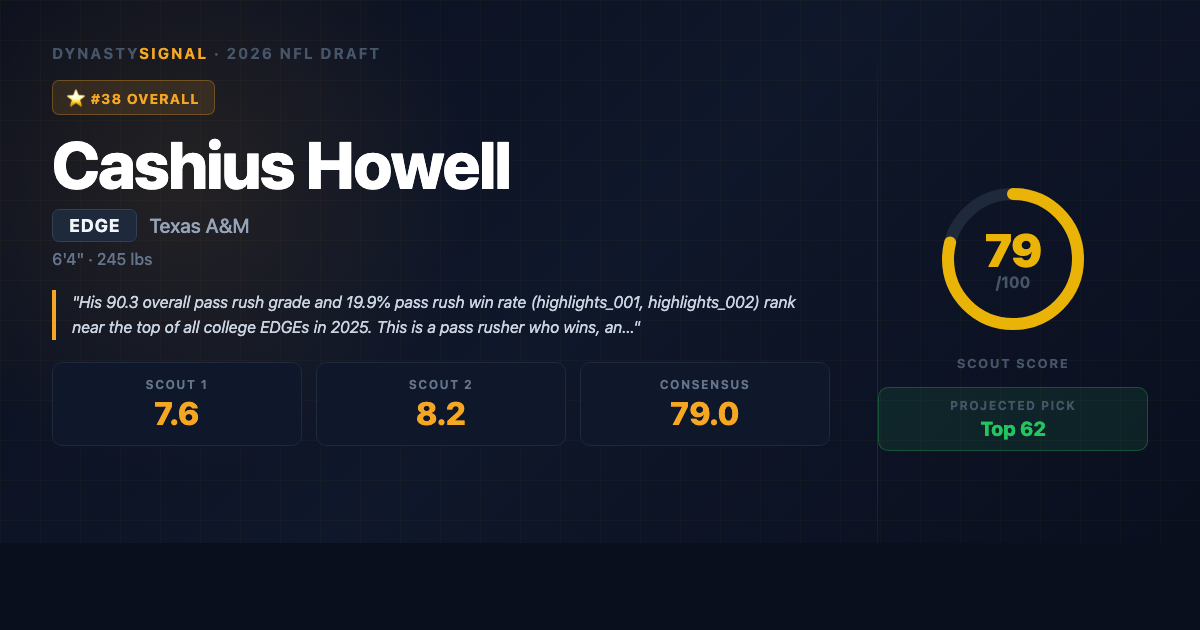
Cashius Howell took an unusual path to becoming one of the most exciting pass-rush prospects in the 2026 draft class. He started at Bowling Green in the MAC, racked up 9.5 sacks in a sophomore season that earned national attention, transferred to Texas A&M, spent a year adjusting to SEC blocking schemes, and then erupted: 11.5 sacks in 13 games, 14.0 tackles for loss, a 90.3 PFF pass rush grade that placed him near the top of all college edge rushers in the country. The trajectory — MAC prospect to SEC star in two years — is exactly the kind of development arc that makes draft evaluators lean forward.
What Howell brings to a pass-rush unit is uncommon: he doesn't just have one elite move. He has a bag. The dip-and-rip around the edge is as clean as you'll see at the college level — both hands free as he bends, which means he's not fighting through a tackle's grip while he corners. He supplements it with a legitimate inside counter off the speed threat, a push-pull move when he reads the tackle over-setting, and the kind of real-time creativity that gets described as "instinctive" — the ability to process what the blocker is giving him and adapt his rush accordingly. His 86.5 True Pass Set pass rush grade (exclusive to pure pass-rush situations) is the number that validates the eye test. He wins in real one-on-one matchups, not just on stunts or surprise pressures.
The get-off is where it starts. Multiple rep sequences show him already wide on the tackle by the time adjacent linemen have moved a foot. This isn't cheating off the snap count — this is genuine explosive twitch, the kind that can't be coached and can't be simulated in the weight room. Against LSU, against Missouri in overtime, against Auburn and South Carolina — the left side of opposing offensive lines had answers for nearly everything except his first step and what came immediately behind it.
STRENGTHS
The dip move is elite. In his best pass-rush rep against Clemson, Howell attacks the right tackle's outside shoulder with a speed rush, drops his inside shoulder to an extreme lean angle — body nearly at 45 degrees to the ground — rips through the tackle's punch and turns the corner clean. The tackle is reaching into air. For a player of his frame to execute that move at that angle against an ACC-quality left tackle is a physical achievement that marks him as a genuine pass-rush talent, not just an athletic freak. NFL coaches who watch that rep circle it, write something in the margin, and come back to it.
His motor is equally defining. Across game film covering Missouri, Auburn, South Carolina, LSU, and BYU, he chases plays from the backside, works through blockers when the primary rush lane closes, and shows up in pursuit at the sideline on runs he has no statistical chance to stop. His tackle-for-loss production (35.5 career TFLs) reflects both pass rush wins and chase-down run plays — the motor converts itself into real production, not just effort grades. The transition from Bowling Green to Texas A&M also demonstrates character: adjusting to SEC-level blocking while posting 4.0 sacks in a developmental year, then breaking through with 11.5 in his senior campaign, shows a player who learns and adapts.
The 19.9% pass rush win rate in 2025 is the other number to know. That's not a lucky sack total against weak opponents — that's a sustained rate of winning one-on-one battles across a full season in the SEC, the league that produces the most NFL offensive linemen.
CONCERNS
The run defense grades are uncomfortable. His 3.1% run-stop rate and 73.6 run defense PFF grade are bottom-quartile numbers. The alignment data tells the structural story: across 2023, 2024, and 2025 combined, he has logged zero snaps in the A or B gap. Texas A&M's coaching staff, in a 9-0 conference run, kept him exclusively on the perimeter — and when a staff that successful doesn't trust a player in certain alignments, that's a meaningful data point. On run plays directed at his gap, he can get washed out by blockers who engage him early. His lighter frame (~240–245 lbs) gets moved by guards and tackles who win the initial engagement with any authority. In the NFL, short-yardage situations against power run teams will push him off the field until he develops the run-stopping craft to hold his position.
His hand technique is the other flag. Analysts who watched the full tape noted that his arms can get wild in pass rush follow-through — sloppy rip-and-swim mechanics after winning the initial edge create opportunities for NFL tackles with superior hand discipline to grab cloth and disrupt the finish. He'll need to tighten up his punch and recovery mechanics at the next level. The transfer year at Texas A&M also showed a player who needed time to adjust to elite competition — a similar adjustment curve at the NFL level could limit his production in Year 1.
SCOUT GRADES
Scout 1 grades Howell at 76/100, projecting round 2, pick 45–62, and places him firmly in the "elite pass rusher, limited early-down player" box — the Robert Mathis archetype of a situational specialist who develops into a double-digit sack every-down starter over time. Scout 2 grades him at 82/100 with a similar pick range, is more optimistic about his power conversion and run-defense upside, and draws a "Will Anderson-lite" ceiling comp if the strength development program goes well. Both scouts agree on the elite first step, the legitimate bag of pass-rush moves, and the run-defense limitations that will suppress his early-down snap count. The Robert Mathis comparison from Scout 1 is the most instructive: Mathis was a fifth-round pick who became a 19.5-sack player after years of developing his counter moves and adding power to his game. Howell's floor is "situational pass rusher" and his ceiling is exactly that arc.
PROJECTION
In a 3-4 OLB role where his pass-rush ability is maximized in clear passing situations, or as the weak-side DE in a 4-3 system that manages his early-down snap count while developing his run-stopping craft, Howell becomes a matchup problem for offensive tackles in ways that justify the investment. Teams like Pittsburgh, Green Bay, or San Francisco — organizations with pass-rush-centric defensive philosophies and experienced position coaching — are the ideal landing spots. The Danielle Hunter developmental arc is the template: lean, long, speed-first edge rusher who needed specific scheme deployment and added functional strength to become an every-down starter. Howell's 2025 season suggests the pass-rush instincts are already there. Whether the rest fills in determines if he's a 10-sack starter or a 6-sack specialist.
View Cashius Howell's full player profile, measurables, and scouting breakdown →
🎬 All-22 Film Analysis Update
*Updated after All-22 film review by Scout1 and Scout2.*
Film Score: 79.0/100 (→ No change from base score of 79.0)
Composite Score: 77
Scout1 Assessment Cashius Howell is one of the more exciting pure pass rushers in the 2026 draft class — a twitchy, explosive edge rusher with an elite first step, a world-class dip move, and the kind of instinctive rush creativity that doesn't get coached in. He transferred from Bowling Green (MAC) and erupted for 11.5 sacks in his senior season at Texas A&M, posting a 90.3 PFF pass rush grade against SEC competition. The case against him is equally clear: he has a 3.1% run-stop rate, has never lined up in the A...
Scout2 Assessment Howell is no David Bailey clone – he's twitchier, more violent, but rawer. Bet on the burst over the polish; mid-Day 2 value in a weak EDGE class.
*Film analysis is based on All-22 footage reviewed independently by two scouts. Scores reflect on-field evidence and may differ from pre-film model projections.*