
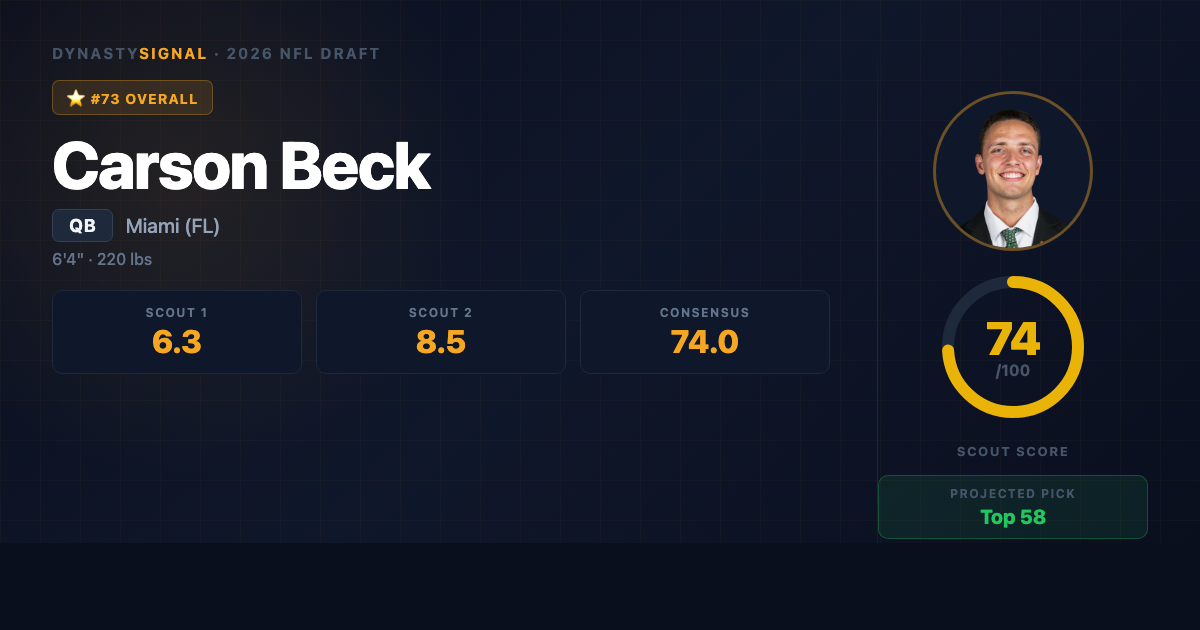
Carson Beck took the long road to NFL Draft relevance — and it just might work in his favor. After a promising 2024 season at Georgia was derailed by a significant elbow injury and a catastrophic CFP semifinal collapse, Beck transferred to Miami and rewrote his narrative in one clean season: 74.7% completion rate, 3,072 yards, 27 touchdowns against an ACC slate that included Notre Dame, Florida State, and Louisville. That's not a cupcake schedule. That's a quarterback doing what he was always supposed to do — running a clean operation, making the right throw, and not losing games.
What makes Beck genuinely interesting for dynasty purposes isn't the flash — he doesn't have much. It's the consistency. In a 2026 class that may lack a consensus franchise quarterback, Beck's processed-offense ceiling is suddenly more valuable than it would be in a deep year. He's 6'4", he throws with anticipation, he hits receivers on the break, and he fits the modern NFL spread offense like a hand in a glove. The right landing spot could turn him into a legitimate starter within two seasons. The wrong one — a thin offensive line, an improvisation-heavy scheme — and he's a backup. The gap between those two outcomes is everything.
STRENGTHS
Beck's most projectable trait is also his least flashy: he reads defenses before the snap and throws to the right guy. Film from a dedicated USF breakdown shows Beck correctly identifying flat-curl and curl-flat combinations, seeing the defender rotate in coverage, and redirecting to the exposed receiver — not because he got lucky, but because he processed it. That kind of pre-snap operation translates directly to the NFL. Too many college QBs lock onto a primary read and fire regardless; Beck demonstrates genuine field scanning and distribution discipline.
His accuracy is the real calling card. The 74.7% completion rate isn't a product of check-downs and screen passes — film shows Beck threading back-shoulder end-zone routes, hitting tight-window red zone targets in stride, and delivering on timing patterns against legitimate ACC defenses. Against Notre Dame, he put Miami up 13-7 with a red zone completion into a compressed window that required anticipatory placement. Against Florida State in a hostile environment at Doak Campbell, he was making downfield throws in tight spots. The ball placement on intermediate routes is consistently above average — he's hitting receivers in stride with proper velocity calibration, which is exactly what NFL scouts want to see.
Beck's pocket operation is fundamental and sound. His footwork in the shotgun is clean — he sets his base, steps into throws, and doesn't short-arm under pressure. The pre-snap cadence is calm, he works through structured read progressions, and he doesn't bounce-throw or bail prematurely when the pocket compresses. In a spread-heavy NFL landscape that rewards QBs who can efficiently process pre-snap motion and zone rotations, Beck's operating style is tailor-made for a Kyle Shanahan or Sean McVay–style system where design reduces post-snap decision load.
CONCERNS
The most obvious limitation in Beck's profile is one that 55 film frames make impossible to hide: he doesn't run. Across three different film sources including a full regular season highlight reel, there is effectively zero meaningful quarterback rushing. No scrambles, no extended plays with his legs, no designed runs. That's not a coincidence — that's a profile. At the NFL level, contain rushers and stunts will expose any QB who can't extend plays with his feet, and Beck will need above-average offensive line play just to reach his baseline. Add the 2024 elbow injury into that equation — a QB who can't run is doubly reliant on arm health and a clean pocket — and the durability picture gets cloudier.
The other concern is performance under elite pressure. The Louisville game, where Miami trailed 14-0 early, is the most uncomfortable data point in this package. A 5-0 Miami team getting buried by a quality front seven raises questions about how Beck's deliberate processing tempo holds up when NFL-caliber pass rushers are collapsing the pocket in under three seconds. His age (approximately 24 at draft time) compounds this: there's limited developmental upside, meaning what you see is largely what you get. The system dependency is real — Miami's offensive design gave Beck pre-snap answers throughout the season, and NFL defensive coordinators will take those away.
SCOUT GRADES
Scout 1 graded Beck at 63/100 with a projected landing spot in the second round (picks 40–58). The evaluation credits his elite completion percentage as genuine — backed by pre-snap processing film evidence, not just soft-zone completions — and praises his red zone efficiency and intermediate ball placement. The drag on the score is the near-zero rushing threat, the elbow injury history, the system dependency, and a ceiling that reads as "mid-tier starter" rather than franchise QB. The Ryan Tannehill comp (2012 version) anchors the projection: a QB who can run a clean operation and keep a team in games without the athleticism or arm to carry one.
Scout 2 came in considerably more bullish at 85/100, projecting Beck as a first-round pick in the range of picks 10–20. The contrarian read: conventional wisdom trashes the transfer and overstates his 2024 decline, but the tape shows a pocket surgeon with plus accuracy and underrated zip who is being slept on because Miami's offensive line didn't do him any favors. Scout 2's take is that Beck is a Day 1 starter who, plugged behind a real NFL pocket, looks like the best value steal in the 2026 class. The gap between these two evaluations — 63 vs. 85, Round 2 vs. late Round 1 — captures exactly why Beck is interesting: the range of outcomes is genuinely wide.
PROJECTION
For dynasty purposes, Beck belongs in the QB2-with-upside tier of 2026 startup drafts. The floor is a career backup or serviceable bridge starter — the Heinicke outcome, where the accuracy and processing are real but the lack of athletic threat and thin margin for error keep him from holding a job long-term. The ceiling is a legitimate mid-tier NFL starter who posts three straight 4,000-yard seasons in the right system, similar to Ryan Tannehill's best years in Tennessee. That ceiling is worth a pick, but the landing spot matters enormously.
Year 1 is likely a learning year regardless of draft slot — Beck isn't a Day 1 plug-and-play fantasy option even if he's drafted in Round 1. By Year 2, if the offensive line and scheme are in his favor, he could be a streaming QB2 in dynasty. Year 3 is the true evaluation window: either he's established himself as a legitimate starter in a structured offense, or the lack of rushing upside and system dependency have caught up with him. Dynasty owners should roster him as a late-round flier in startups and monitor his NFL landing spot before committing real draft capital.
View Carson Beck's full player profile, measurables, and scouting breakdown →
🎬 All-22 Film Analysis Update
*Updated after All-22 film review by Scout1 and Scout2.*
Film Score: 74.0/100 (→ No change from base score of 74.0)
Composite Score: 73.5
Scout1 Assessment **Report Date:** February 2026 | **Draft Class:** 2026 | **Evaluation Basis:** 55 film frames across three sources
Scout2 Assessment Beck's no bust—conventional wisdom trashes his transfer and \"decline,\" but this tape screams pocket surgeon with plus accuracy and underrated zip. Contrarian take: He's a Day 1 starter who gets slept on because Miami's O-line crumbles; plug him behind a real pocket and he's top-15 2026 steal.
*Film analysis is based on All-22 footage reviewed independently by two scouts. Scores reflect on-field evidence and may differ from pre-film model projections.*