
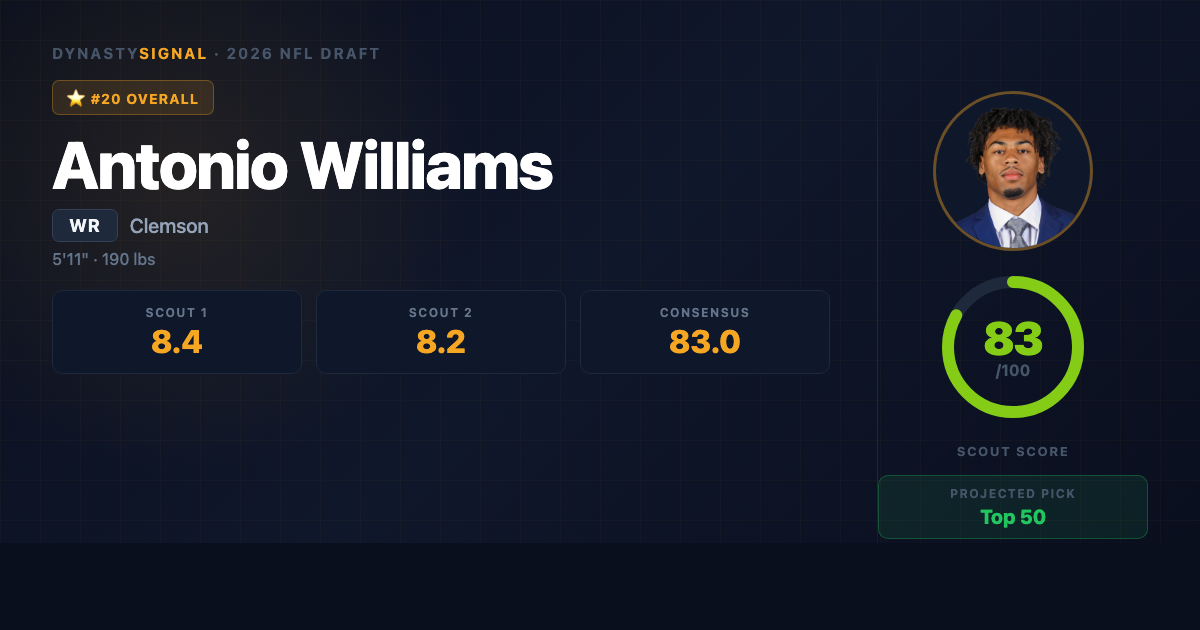
Antonio Williams doesn't need to be the flashiest receiver in the 2026 NFL Draft to be the most valuable one for dynasty managers. The Clemson senior quietly put together one of the most complete statistical resumes in this class — 75 receptions, 904 yards, and 11 receiving touchdowns in 2025, the latter tying for the ACC lead. Across three seasons as a starter, he's accumulated 153 catches, 1,732 yards, and 17 receiving touchdowns on an offense that wasn't always winning games. That's not a one-year wonder; that's a pattern.
What sets Williams apart isn't raw athleticism — it's the combination of production, physicality, and scheme versatility that makes him appealing in almost any NFL context. CBS Sports ranked him the No. 1 wide receiver in pre-draft summer scouting, and the film backs it up: a compact, muscular receiver who wins at the intermediate level, punishes defenders after the catch, and scores near the goal line with regularity. The question for dynasty managers isn't whether he can play — it's where he lands and how quickly he earns targets.
STRENGTHS
Williams' most distinguishing trait on film is what CBS Sports analysts called "elite after the catch" — and the footage earns that label. He consistently absorbs contact and keeps his legs churning rather than going to the ground on first contact. His muscular, running-back-like build (approximately 195 lbs. at 6'1") is purpose-built for YAC situations: highlights from the UNC game show him driving through a defensive back with his shoulder before breaking upfield, and a night-game clip against FSU captures him accelerating away from a defender after securing a mid-range route. This isn't luck — it's a built-in edge that generates big plays off short and intermediate throws.
His route running and hands are polished for a player at his stage. Film from a shallow crossing route shows a crisp cut at 6–8 yards with immediate burst out of the break, while a curl/dig trace reveals clean stem mechanics and a sharp inside break — the kind of technique that tells you he understands leverage and coverage manipulation. He doesn't telegraph breaks, and 75 receptions on a Clemson team that was 3-4 at points during the season confirms he was the go-to option even in adversity. Catch radius is reliable; he catches away from his body and looks natural in contested situations near the sideline and in the end zone, with TD catches versus Duke and FSU showing textbook body control.
Williams' scheme versatility is the third pillar of his pro case. Film shows him aligned in the left slot, split wide as an outside receiver, and flexed near the line of scrimmage across different game situations. He's not position-locked. Eleven red zone touchdowns in a single season signals that the Clemson staff trusted him at the game's most premium real estate — a vote of confidence that carries significant weight for dynasty evaluators projecting NFL target share and touchdown upside.
CONCERNS
The primary concern is his vertical passing game impact. A 12.1 yards-per-reception average and a relative absence of deep route development in the film suggest Williams is not a true vertical separator. He appears to do almost all his damage 0–20 yards from the line of scrimmage, which means NFL defensive coordinators who can bracket him underneath and force the quarterback to look elsewhere may be able to limit his ceiling. A 57-yard reception confirms he can threaten downfield when given a clean release, but it's the exception, not the pattern. His release package also drew scrutiny in the film — against NFL-caliber press corners, he'll need to improve at the top of routes.
The ACC competition level will also face fair scrutiny at the next level. His production numbers are impressive in context, but the conference's defensive backs are a tier below what he'll see on Sundays. If combine measurables disappoint — specifically if the 40-yard dash comes in above 4.55 — some teams will mark him down from first-round consideration regardless of the statistical resume. The range of outcomes here is meaningful: a strong combine pushes him into the late first; a mediocre combine puts him firmly in the Day 2 conversation.
SCOUT GRADES
Scout 1 came away bullish, awarding an overall grade of 84/100 with a projected pick range of late first round (picks 20–32), with downside to early second (picks 33–45) if measurables disappoint. The report highlighted elite YAC, red zone reliability, and route diversity as the primary drivers of the grade, drawing a primary NFL comparison to Amon-Ra St. Brown and a secondary comp to early-career Tyler Lockett. The overall assessment: Williams is the "dynasty manager's ideal buy" — high floor, legitimate WR1 ceiling in the right scheme.
Scout 2 offered a more tempered read at 82/100, projecting a Round 2 landing (picks 35–50) and centering concerns on his limited outside speed, underdeveloped release package, and unproven ability against elite press coverage. Trait grades were illuminating: YAC/elusiveness (9/10) and hands (8/10) confirm the physical tools, but route running (6/10) and release/speed (4/10) flag real refinement needed before he can function as a true WR1 at the next level. Comps ranged from Curtis Samuel (floor) to an Amani Cooper-lite ceiling. Both scouts agreed the YAC production is legitimate; the debate is simply how high the ceiling goes.
PROJECTION
For dynasty managers, Antonio Williams profiles as a high-floor WR2/WR3 with genuine WR1 upside in a scheme that maximizes intermediate targets and YAC opportunities — think West Coast or Shanahan-style concepts, motion-heavy offenses with a dynamic quarterback distributing quickly. Year 1 he's a PPR flex with upside; if he's drafted by a team with an established offensive system and consistent quarterback play, he could be a low-end WR2 by Week 10 of his rookie season. His 11 touchdown track record signals an offense will quickly learn to feature him near the goal line.
By Years 2–3, the trajectory depends almost entirely on role consolidation. Receivers with Williams' physical profile and YAC ability tend to see their target share grow as coordinators build around their strengths — and 153 career receptions at the college level suggest he's reliable enough to earn that trust. The comp to Amon-Ra St. Brown isn't just flattery; it's a realistic outcome model. St. Brown was a third-round pick who became a WR1 because of precisely these traits. Williams' draft position will likely be higher, but the developmental arc is similar. Buy him at his draft cost, especially if that cost reflects Day 2 draft capital.
View Antonio Williams's full player profile, measurables, and scouting breakdown →
🎬 All-22 Film Analysis Update
*Updated after All-22 film review by Scout1 and Scout2.*
Film Score: 83.0/100 (→ No change from base score of 83.0)
Composite Score: 84
Scout1 Assessment Antonio Williams is the most complete receiver in the 2026 draft class — a compact, muscular flex weapon who does everything well and nothing badly. He's not a 6'2" boundary burner, but he's a three-year Clemson starter who led the ACC in receiving touchdowns (tied, 11), ranked third in receptions (75), and accumulated 1,732 yards and 17 TDs over his career — numbers that don't lie. The case for him is volume, consistency, touchdown production, and an ability to win inside and outside in multipl...
Scout2 Assessment **The Short Version** Antonio Williams is a YAC dynamo in the slot who feasts on college screens and underneath stuff, but the \"elite after-catch\" hype ignores his limited outside speed, shaky deep-ball tracking, and average release package. Solid Day 2 slot converter, not a WR1 maker.
*Film analysis is based on All-22 footage reviewed independently by two scouts. Scores reflect on-field evidence and may differ from pre-film model projections.*