
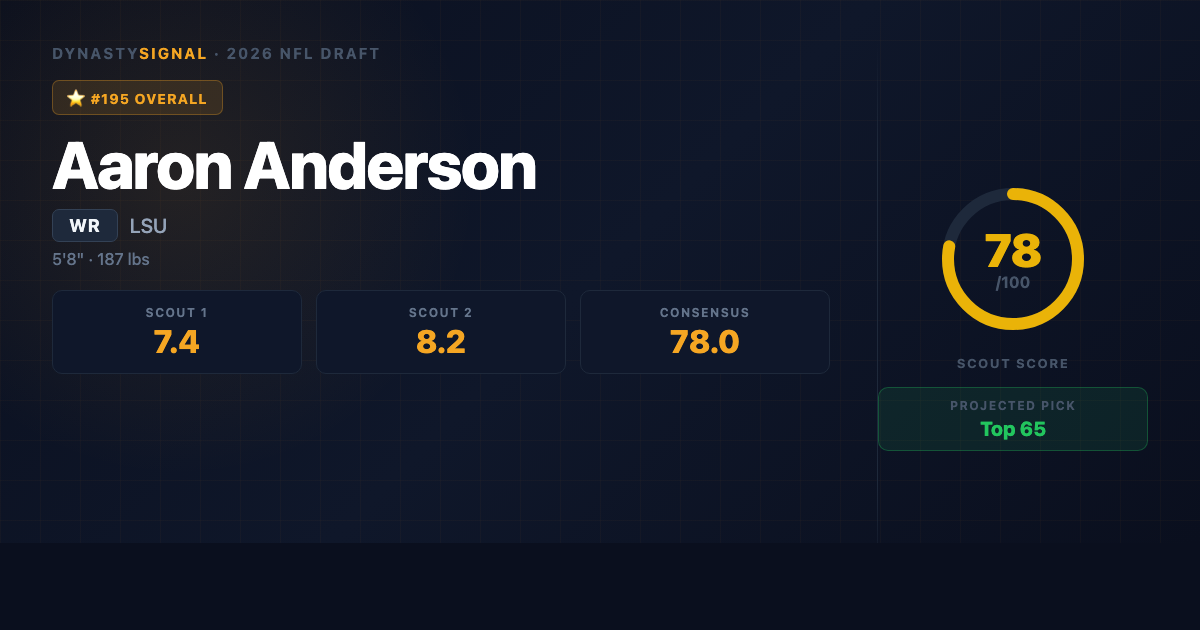
When LSU's leading receiver walks into a room, people notice — not because of his size, but because of what he does with it. Aaron Anderson finished the 2024 season as the Bengals top target in Brian Kelly's SEC offense, hauling in 61 catches for 884 yards and earning a Senior Bowl invitation that put him in front of every NFL front office in the country. CBS Sports slotted him as the #3 wide receiver in the 2026 draft class over the summer, and after watching the film, it's easy to see why evaluators keep gravitating toward his tape.
What makes Anderson compelling for dynasty is the rare combination of college production at a premier program and a skill set that translates cleanly to the modern NFL. He's not a one-trick speed merchant — he led an LSU receiving corps stocked with NFL-caliber talent, operating as the go-to option across a full SEC schedule that included Clemson, Ole Miss, and Texas A&M. The question isn't whether he can play at the next level. It's whether the right team finds him first.
STRENGTHS
Anderson's calling card is elite straight-line speed, and the film makes it unmistakable. Against South Carolina on a 2nd-and-14 — a down where defenses are locked in and set — he stacks two SEC defensive backs on a vertical route and creates clear daylight in front of him. Against Ole Miss, a routine short completion immediately becomes a footrace, with the nearest defender angling desperately and losing. His stride mechanics at full speed are fluid and long for his frame, with natural lean and efficient arm drive. If the Combine numbers match what the film suggests, Anderson could put himself into the first-round conversation on athleticism alone.
But speed alone doesn't explain how he led LSU in receiving — route nuance does. Senior Bowl practice footage shows him executing a crisp cut against a defensive back with clean stem work and footwork at the break, not just running straight lines. He works across multiple alignments in the LSU film: outside the numbers on vertical shots, in motion through formations, and in space-creating third-down situations against Florida. He's best getting into routes quickly off the line and using speed to threaten vertically before breaking underneath, but the footwork building blocks are there for a more advanced release package at the next level.
His toughness is the surprise. For a slender-framed receiver, Anderson competes through contact in ways that matter for NFL evaluations. In the Clemson matchup — against one of the better defenses in the sample — he's in physical contested-catch moments and doesn't flinch. He secures the ball at the catch point, body low, arms disciplined. His hands are clean throughout the sample with no glaring drops, and Senior Bowl jump-ball drill footage shows excellent vertical explosion with extended arms at the apex and sound technique at the highest point of his jump. The jump-ball ceiling is higher than his frame would suggest.
CONCERNS
The frame is real and it matters. Anderson is on the smaller end for an NFL outside receiver, and the film reflects it clearly — against simultaneous two-man tackles in the open field, the play ends. NFL corners will jam him at the line more consistently than SEC corners did, and his release package will need refinement to handle press coverage at the next level. His contested-catch production in traffic also carries a size caveat: NFL safeties and corners have length advantages at the catch point that most college defenders didn't bring. He wins some 50/50 balls, but evaluators noted he can be outmuscled by physically dominant corners.
The bigger dynasty concern is volume dependency. Anderson's value is almost entirely tied to target share — land him in a scheme that deploys speed-based receivers in space and you're looking at a legitimate fantasy contributor; land him in a loaded WR room or a run-heavy system and he fades quickly. He profiles as a Day 2 pick, which means roster uncertainty is real. He's also a non-factor as a blocker, which limits the percentage of plays where he's a positive contributor on early downs. These are manageable risks, not disqualifying ones — but dynasty managers need to price them in at draft time.
SCOUT GRADES
Scout 1 graded Anderson at 74/100 with a Day 2 projection of picks 45–65, emphasizing his elite vertical speed (A-/8.5), polished footwork for a speed-first receiver (B/7.0 route running), and clean hands (B+/7.5). Scout 1's primary concern was frame-dependent durability and a blocking profile that limits run-game involvement. The NFL comp landed on a Kadarius Toney/Rashee Rice hybrid — explosive enough to be a genuine weapon, with enough route polish to be more than a gadget piece — and identified the Rashee Rice Year 1 breakout ceiling as the realistic dynasty upside in the right scheme.
Scout 2 graded Anderson at 82/100, projecting a similar Day 2 range of picks 40–60. Scout 2 was more bullish on his hands and ball skills (9/10), flagging his catch radius and body control in traffic as genuine strengths, and rated his route-running separation at 8.5/10 with particular praise for his crisp stems and break-selling in Senior Bowl drills. Scout 2's comp ceiling was Calvin Ridley — a precise, reliable 1,000-yard receiver — with a floor of Hollywood Brown as a quick, YAC-oriented slot threat. The contrarian note from Scout 2: if Anderson tests average athletically at the Combine, he becomes a Day 2 value steal rather than a reach.
PROJECTION
Anderson's dynasty floor is a depth receiver who finds his way onto a 53-man roster and carves out a role on third downs and in sub-package formations — a WR4/5 with a real chance to climb. The ceiling, with a landing spot in a pass-heavy spread system (think Cincinnati, Miami, or a West Coast operation that manufactures space), is a legitimate WR2 by Year 3 with an 80–100 target season and 900–1,100 receiving yards. He's not going to step in as an alpha WR1, but that's not the bet. The bet is a scheme-fit hit that unlocks the speed and route competency he showed against SEC competition.
For dynasty rookie drafts, Anderson sits comfortably in the 2nd-round range — not a player to reach for in Round 1, but one to target aggressively in the 2.01–2.08 window before his NFL landing spot narrows the field. If he runs a legitimate 4.38–4.42 at the Combine and lands somewhere like Cincinnati or Philadelphia, the price goes up immediately. Stash him now, monitor his destination, and revisit with conviction if the scheme fit materializes. The boom case is real; the bust case is just as real. That's the Aaron Anderson dynasty proposition.
View Aaron Anderson's full player profile, measurables, and scouting breakdown →
🎬 All-22 Film Analysis Update
*Updated after All-22 film review by Scout1 and Scout2.*
Film Score: 78.0/100 (→ No change from base score of 78.0)
Composite Score: 79
Scout1 Assessment Aaron Anderson is an electric, undersized speed receiver who led the LSU receiving corps in 2024 with 61 catches for 884 yards — numbers that speak to volume usage in Brian Kelly's offense at one of the premier programs in college football. The case for Anderson is straightforward: elite straight-line speed that stacks SEC cornerbacks on vertical routes, the quickness and footwork to work as a polished route-runner in the short and intermediate game, and the toughness to compete through contact ...
Scout2 Assessment Anderson's a safe, scheme-versatile Day 2 WR who'll carve Day 2 niche—pass on top-20, grab in R2 for dynasty stash.
*Film analysis is based on All-22 footage reviewed independently by two scouts. Scores reflect on-field evidence and may differ from pre-film model projections.*